



[Domestic] Finding the Path to Peace on the Korean Peninsula with Future Generations
- Peace & Unification Magazine No. 221
- 04-24-2026 ~ 04-24-2026
Finding the Path to Peace on the Korean Peninsula with Future Generations:
Students Take Center Stage in the 2026 Busan Dong-gu Peace & Unification Civic Dialogue
The Peace & Unification Civic Dialogue, a public forum dedicated to fostering discussion on peace and unification, was held at a school—the place where future generations learn and grow. All students of Busan Dong Girls' Middle School gathered in the auditorium to reflect on the meaning and value of peace and unification while exploring practical ways young people can help build public support for peace and unification in their local communities.
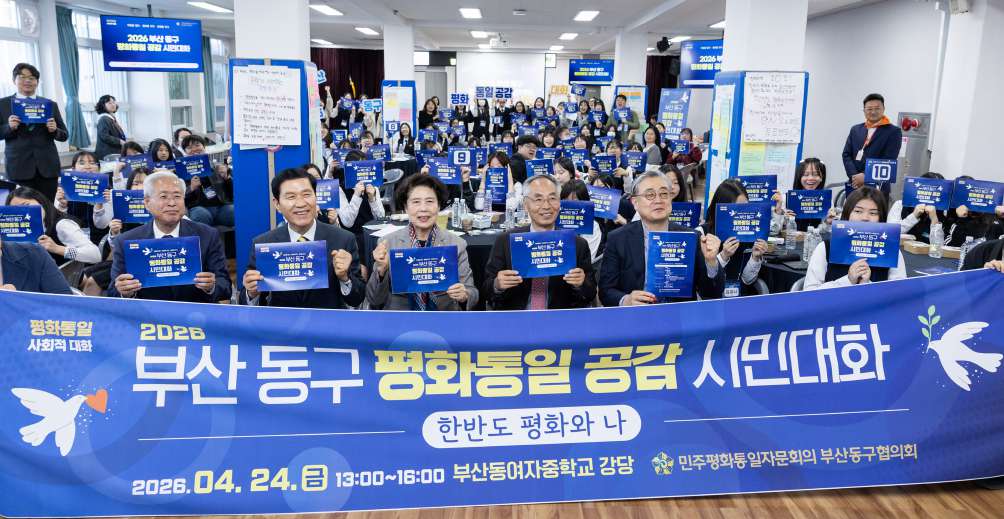
The 2026 Busan Dong-gu Peace & Unification Civic Dialogue drew a full audience at the auditorium of Busan Dong Girls' Middle School.
Taking the Peace & Unification Civic Dialogue to Schools
On April 24, the 2026 Busan Dong-gu Peace & Unification Civic Dialogue was held in the auditorium of Busan Dong Girls' Middle School. The event was organized by the Preparatory Committee for the 2026 Busan Dong-gu Peace & Unification Civic Dialogue and hosted by the Busan Dong-gu Municipal Chapter of the Peaceful Unification Advisory Council (PUAC), chaired by Kang Young-ja.
Held under the overarching theme "Peace on the Korean Peninsula and Me," this school-based edition of the Peace & Unification Civic Dialogue provided a meaningful opportunity for students to share their perspectives and explore practical ways young people can help build public support for peace and unification in their local communities.
The opening ceremony brought together Kang Young-ja and Council Members of the Busan Dong-gu Municipal Chapter, Bae Yong-han, Vice-chairperson for the Gyeongbuk region, Song Soon-cheol, Director General of the Council Member Assistance Bureau of the Secretariat of the PUAC, Professor Park Ju-hwa of the University of North Korean Studies, Kim Hae-yeon, Principal of Busan Dong Girls' Middle School, and approximately 80 students.
In her opening remarks, Kang Young-ja, Chair of the Busan Dong-gu Municipal Chapter, stated, "Peace and unification on the Korean Peninsula are not distant aspirations but issues that affect your lives today." Referring to the event's slogan, "Open Hearts, Build Peace, Connect Through Unification," she added, "In keeping with the spirit of this slogan, I hope every student will open your heart and freely share your thoughts on peace and unification." She further remarked, "The more we learn to understand one another and communicate in our communities, schools, and everyday lives, the closer we will come to peace and unification." She reaffirmed the chapter's commitment, saying, "The Busan Dong-gu Municipal Chapter will continue to faithfully serve as a platform for dialogue on peace and unification."
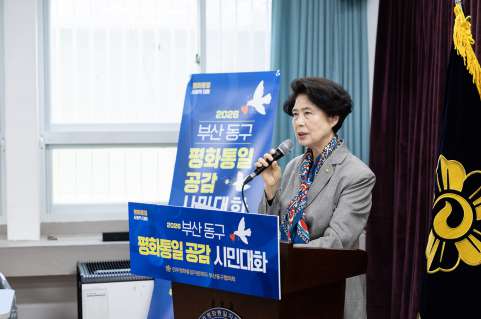
Emphasizing that "peace and unification are issues of today," Kang encouraged students to participate with open minds and share their thoughts freely.
A Wide Range of Perspectives on Peace on the Korean Peninsula
The program began with a quiz on peace and unification designed to gauge students' perceptions while generating interest in the discussion.
Students warmed up by answering true-or-false questions such as, "There is also a province called Gangwon in North Korea." When asked, "If you were to rate the current state of peace on the Korean Peninsula, what score would you give it?" more than half of the participants—44 students—chose a middle score of four or five, suggesting that the long-standing division of the Korean Peninsula and recent tensions have influenced young people's perceptions of peace. In response to the statement, "Listening to other people's opinions makes dialogue more difficult," the vast majority answered "False," reflecting the event's emphasis on open communication.
As expected, the roundtable discussions got off to a smooth start. Divided into ten groups, the students first organized their thoughts on the question, "What does peace on the Korean Peninsula mean?" before sharing them with their classmates under the guidance of group facilitators. Their thoughtful responses included ideas such as "South and North Korea respecting one another without conflict or war," "everyone living on the Korean Peninsula understanding and caring for one another," and "the two Koreas recognizing their differences while supporting each other where needed." The steady stream of thoughtful and mature responses repeatedly drew expressions of admiration from both the moderators and the facilitators.
The second discussion topic asked, "How does the situation on the Korean Peninsula affect me?" Responses to the first question—whether students considered the current situation on the Korean Peninsula to be peaceful—were almost evenly divided. Those who answered "peaceful" generally pointed to the absence of any immediate armed conflict or war, while those who answered "not peaceful" cited the armistice that has remained in place for more than half a century and the prolonged period of strained inter-Korean relations in recent years. The second question asked, "How much does the current situation on the Korean Peninsula affect your life?" Most students selected "a little" or "moderately," while relatively few chose "a great deal." This largely reflected the fact that no visible conflict is currently taking place. However, students who selected "a great deal" expressed concern that they could lose many things if war were ever to break out. In response to the third question—"What is needed to achieve peace on the Korean Peninsula?"—students proposed a variety of ideas centered on dialogue, listening, understanding, respect, and consideration for others. Their responses closely reflected the purpose of the Peace & Unification Civic Dialogue.
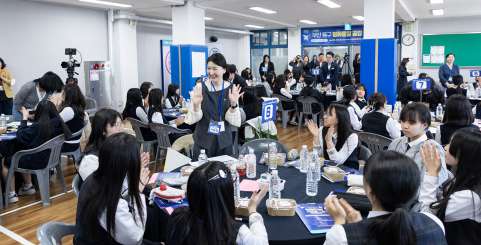
Guided by their facilitators, the students freely exchanged ideas as the roundtable discussions unfolded in a lively atmosphere.
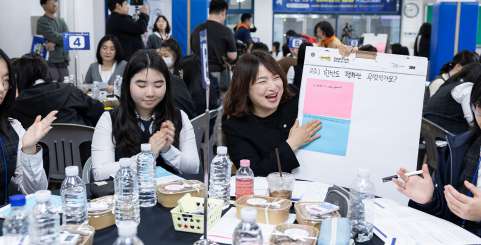
Students enthusiastically preparing presentations for the roundtable discussions
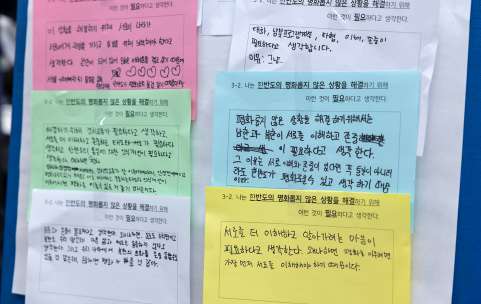
Students' Thoughts on Peace and Unification
Having recognized the diversity of opinions and engaged in respectful discussion, the students broadened their perspectives on peace on the Korean Peninsula by listening carefully to one another. They then moved on to their final group assignment.
Working under the theme, "What can our community do to promote peace on the Korean Peninsula?" the students first organized and presented their individual ideas before developing concrete group action plans based on their collective discussions.
Group 1 proposed a "Unification Poster Contest" for Dong-gu residents to help visualize a reunified Korean Peninsula and raise awareness of the importance of peace and unification. Group 2 suggested offering public education programs on unification, followed by regular "Korean Peninsula Peace Knowledge Competitions," with the events promoted through social media. Group 3 proposed renovating vacant houses throughout Dong-gu into affordable accommodations featuring exhibits and content related to peace and unification on the Korean Peninsula, with the goal of fostering broader public support for unification. Group 4 presented the idea of establishing regular peace and unification education programs for Dong-gu residents. Group 5 proposed issuing debit and credit cards featuring designs inspired by North Korean landmarks and culture that people could experience after unification.
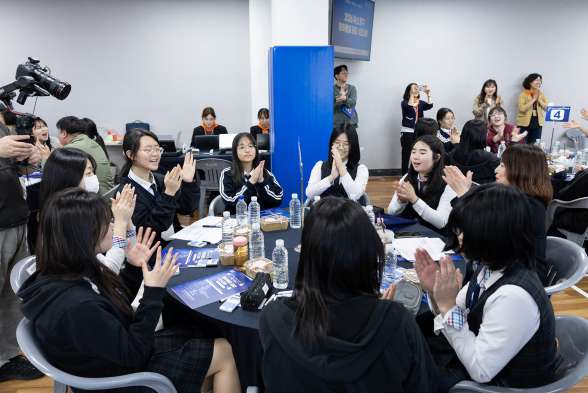
Group 6 advocated transforming Dong-gu's Ibagu-gil, a walking trail steeped in the history of the Korean War, into a peace and unification promotional trail. Group 7 encouraged students of Busan Dong Girls' Middle School to distribute peace and unification posters at locations such as Busan Station and take part in related public campaigns. Group 8 proposed creating and actively managing a Dong-gu social media account dedicated to peace and unification, featuring hashtag campaigns, photo-sharing initiatives, and posts introducing examples of national reunification from around the world. Group 9 recommended using generative AI to compile accurate information about North Korea and actively share it with others. Group 10 proposed launching a social media dance challenge to raise awareness of peace on the Korean Peninsula. Following the presentations, participants voted for the most outstanding proposals, with Group 3 receiving first place and Groups 1 and 2 tying for second, earning enthusiastic applause.
To conclude the program, students responded to four statements: "There are viewpoints on peace and unification that differ from my own," "People whose views on peace and unification differ from mine have their own reasons," "I can express my own views while respecting those who think differently," and "My views on peace and unification may change through dialogue." For all four statements, "Strongly Agree" was the response selected by the largest number of students.
The students also joined together in a pledge to recognize and respect one another's differences, deepen mutual understanding, and communicate more openly about peace on the Korean Peninsula and unification. They all raised their voices in unison as they made this commitment. It was a powerful reminder that these students are ready to engage in meaningful discussions about peace and unification on the Korean Peninsula and to work together in search of the best way forward.
Launched this past March in Gimpo, the Peace & Unification Civic Dialogue series is scheduled to hold a total of 39 events this year—34 in Korea and five overseas. It will continue to serve as a public forum for dialogue on peace on the Korean Peninsula by gathering diverse public perspectives on peace and unification and identifying practical action items for local communities.
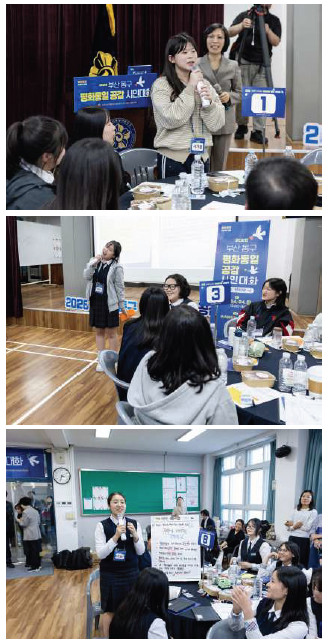
Representatives from each group confidently presented the ideas developed through the roundtable discussions.
Brief Interviews
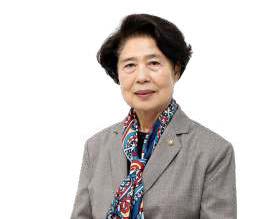
Kang Young-ja
PUCA Chair, Busan Dong-gu Municipal Chapter
"The Busan Dong-gu Municipal Chapter carries out a wide range of programs to promote the values of peace and unification among children and young people. As an extension of those efforts, we decided to hold the Peace & Unification Civic Dialogue at Busan Dong Girls' Middle School.
Watching the students engage in thoughtful discussions about peace on the Korean Peninsula and work together to develop what they believed were the most effective practical initiatives naturally gave me confidence that the future of peace on the Korean Peninsula is bright."

Yoon Eun-hwi
Second-Year Student, Busan Dong Girls' Middle School
"As late as yesterday, I thought peace and unification on the Korean Peninsula were things that only people in positions of leadership could bring about. But after talking with my friends today about peace on the Korean Peninsula and coming up with practical ideas that we can carry out in our community, I realized that achieving peace and unification requires the efforts of all of us. From now until the day genuine peace comes to the Korean Peninsula, my friends and I will continue doing what we can to help make that future a reality.”
-
How satisfied are you with the information you have reviewed?