



2026 Korea–U.S. Peaceful Unification Forum
- Peace & Unification Magazine No. 221
- 05-01-2026
2026 Korea–U.S. Peaceful Unification Forum
Exploring International Cooperation for Peaceful Coexistence on the Korean Peninsula
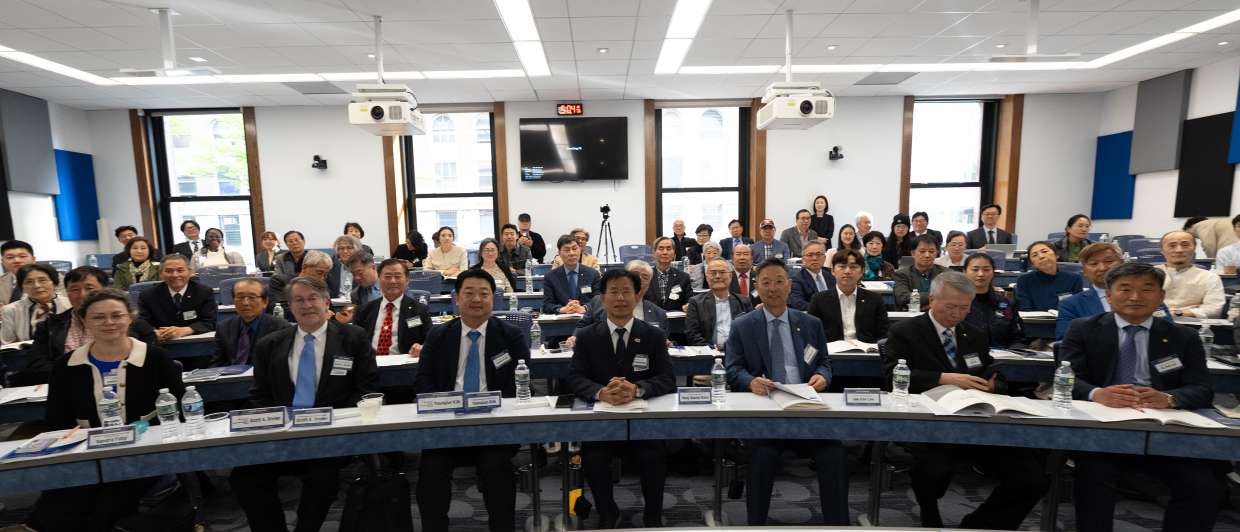
On Friday, April 24, the Peaceful Unification Advisory Council (PUAC) hosted the "2026 Korea–U.S. Peaceful Unification Forum" at Teachers College, Columbia University, in New York City.
Held under the overarching theme "International Cooperation for Peaceful Coexistence on the Korean Peninsula," the forum was organized to assess the impact of recent changes in the international landscape on the policy environment for peace on the Korean Peninsula and to explore the future direction of Korea–U.S. relations and the challenges ahead.
In addition to experts from Korea and the United States, undergraduate and graduate students from local universities also participated, contributing diverse perspectives to the discussions.
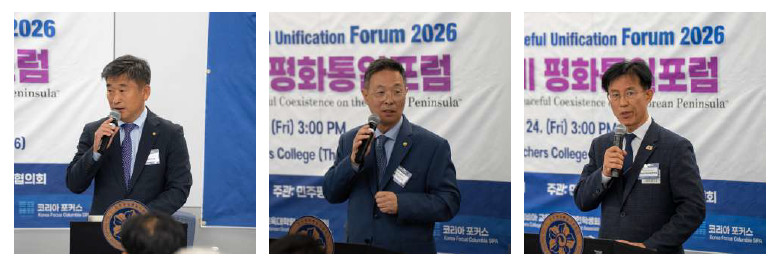
In his opening remarks, Lee Si-hwa, Chair of the New York Municipal Chapter, emphasized the importance of broadening international support for peace on the Korean Peninsula.
In his congratulatory remarks, Vice-chairperson Lee Jae-soo for the Americas emphasized the need for international solidarity in cooperation with overseas Korean communities.
In his keynote address, Secretary General Bang Yong-seung outlined the direction of peaceful coexistence on the Korean Peninsula and emphasized the importance of international cooperation.
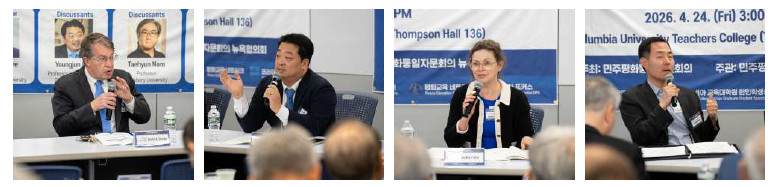
Scott Snyder analyzed the changing international order surrounding the Korean Peninsula and its implications for the policy environment.
Professor Kim Young-jun emphasized the need to rethink North Korea policy in response to the reconfiguration of the major power-led international order.
Associate Professor Sandra Fahy examined the structural characteristics of the Korean Peninsula issue in an era marked by multipolarity and overlapping global crises.
Frank Aum emphasized the need for a pragmatic and flexible North Korea policy suited to today's evolving strategic environment.
A Forum for Korea–U.S. Dialogue on Peace in New York
The forum consisted of an opening ceremony followed by two thematic sessions. The opening ceremony featured welcoming remarks by Lee Si-hwa, Chair of the New York Municipal Chapter of the Peaceful Unification Advisory Council (PUAC), congratulatory remarks by Vice-chairperson Lee Jae-soo for the Americas, and a keynote address by Secretary General Bang Yong-seung.
In his opening remarks, Lee Si-hwa described the forum as "a meaningful opportunity to jointly explore the future of the Korean Peninsula amid rapidly changing international circumstances." He added, "Bringing together experts from Korea and the United States to discuss the future direction of bilateral cooperation is particularly timely." He further emphasized, "Holding these discussions in New York—one of the world's leading centers of international diplomacy—will serve not only as an academic exchange but also as an important opportunity for public diplomacy to broaden international support for peace on the Korean Peninsula."
In his keynote address, Secretary General Bang Yong-seung observed, "Many parts of the world continue to suffer from deep-rooted conflicts among peoples and nations, and as international tensions intensify, peaceful coexistence has emerged as a global imperative." He added, "The Korean Peninsula likewise stands at a critical turning point amid these changes." He further emphasized, "Peace on the Korean Peninsula must begin not with hostility and confrontation but with mutual respect and trust, and the door to dialogue can only be opened when each side recognizes the other's system and sovereignty."
He further stated, "Peace on the Korean Peninsula is an essential prerequisite for safeguarding people's lives and security and for laying the foundation for sustainable development," adding, "It can become even more firmly established with the support and cooperation of the international community." He also noted that the division of the Korean Peninsula is a historical product of the international order and emphasized, "It is now up to us to create the conditions for peaceful coexistence through our own determination and efforts."
With regard to the role of the United States, he emphasized, "As a signatory to the Korean Armistice Agreement, the United States can play an important role in advancing a peace regime on the Korean Peninsula," highlighting the need for cooperation with the international community. He also referred to the role of overseas Council Members and Korean communities abroad, expressing his hope that "international solidarity for peaceful coexistence on the Korean Peninsula will continue to expand."
Moderated by Scott Snyder, President and CEO of the Korea Economic Institute of America (KEI), the first session of the forum brought together three experts from Korea and the United States to assess "The Policy Environment for Peace on the Korean Peninsula in Light of Recent International Developments."
Professor Kim Young-jun of Korea National Defense University characterized recent changes in the international order as "a return to great-power realpolitik." Referring to the Russia–Ukraine war and conflicts in the Middle East, he argued that the U.S.-led liberal international order has weakened while a multipolar system centered on regional powers is becoming increasingly prominent. He also pointed to North Korea's strengthening ties with Russia and China, its continued advancement of its nuclear and missile capabilities, and its redefinition of inter-Korean relations as a "hostile two-state relationship," noting that these developments highlight the limitations of existing North Korea policies. Professor Kim stated, "Both sanctions-based and engagement-based approaches have limitations," and emphasized, "A new strategic approach is needed—one that can deter war while maintaining peaceful coexistence."
Associate Professor Sandra Fahy of Carleton University described today's global landscape as one of "deepening multipolarity and compounded crises." She observed, "The international community is now facing a multi-theatre conflict environment, with an energy crisis, inflation, and slowing growth occurring simultaneously."
Turning to Northeast Asia, she noted, "What was once a manageable competitive structure is shifting toward military and bloc-based rivalry, weakening the role of diplomacy and increasing the risk of miscalculation." She emphasized, "The Korean Peninsula issue is not simply a regional issue, but a structural challenge shaped by the complex interaction of U.S.–China competition, the Russia factor, and other variables," stressing the need for a long-term, multix-x-layered approach.
Frank Aum, Nonresident Senior Fellow at the Stimson Center, emphasized, "Sanctions- and engagement-based approaches alone have their limitations in addressing the North Korea issue. What is needed is a pragmatic and flexible policy response that reflects today's changing international environment."
"The previous x-x-framework of manageable competition is giving way to military and bloc-based rivalry, diminishing the role of diplomacy while increasing the risk of miscalculation.
The Korean Peninsula issue is not merely a regional matter but a structural challenge shaped by the interaction of U.S.–China competition, the Russia factor, and other geopolitical factors."
The second session, titled "Prospects and Challenges for Korea–U.S. Relations in a Changing International Environment," was chaired by Professor Lee Jeong-chul of the Department of Political Science and International Relations at Seoul National University.
During the discussion, Jonathan Corrado, Director of Policy at The Korea Society, argued that a fundamental shift is needed in approaches to the North Korea issue.
Corrado observed, "A 'hybrid approach' combining elements of the Agreed Framework, the Six-Party Talks, and summit diplomacy is unlikely to succeed under today's geopolitical conditions," pointing to the limitations of existing approaches. He further argued that North Korea's expanding cooperation with Russia following the Russia–Ukraine war has significantly strengthened Pyongyang's negotiating position, adding, "North Korea is in its strongest strategic position since the end of the Cold War."
He further argued that the Kim Jong Un regime is pursuing a long-term strategy rather than operating on a short-term policy cycle. He explained, "North Korea has chosen time over negotiations, and the initiative in any future negotiations now rests with Pyongyang."
Turning to the future direction of Korea–U.S. cooperation, Corrado emphasized, "What is needed is not simply sanctions or pressure, but a risk management-oriented approach." He continued, "Rather than treating engagement and deterrence as mutually exclusive, we need a parallel strategy that advances both simultaneously," and proposed phased incentives and flexible policy responses.
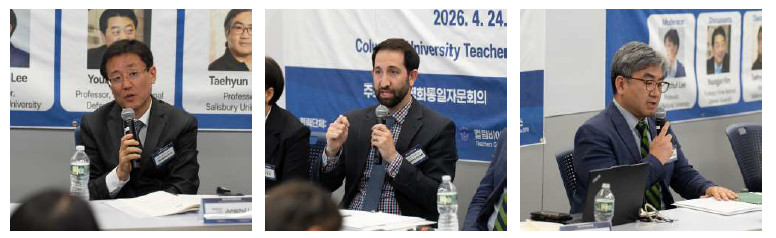
Professor Nam Tae-hyun of Salisbury University stated, "Amid changes in the international order, the Korea–U.S. alliance should evolve beyond traditional security cooperation into a broader strategic partnership." He added, "To achieve this, sustained policy coordination and cooperation between the two countries are essential." Moderating the session, Professor Lee Jeong-chul guided the discussion on the strategic direction of Korea–U.S. relations.
Jonathan Corrado emphasized the need for a fundamental shift in approaches to the North Korea issue and advocated a parallel strategy that advances engagement and deterrence simultaneously.
Professor Nam Tae-hyun highlighted the importance of expanding the Korea–U.S. alliance and maintaining close cooperation.
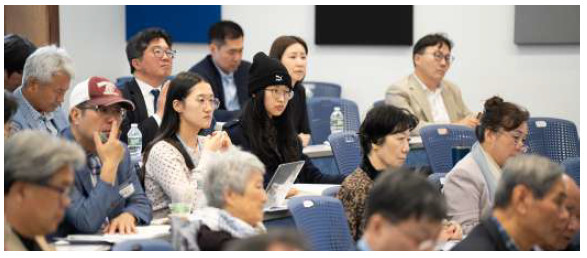
Throughout the session, participants listened attentively to the various proposals for peaceful coexistence presented from different perspectives, broadening their shared understanding.
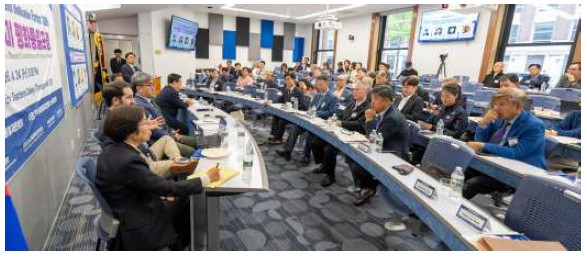
At a roundtable discussion following the forum, local Council Members and leaders of the Korean American community exchanged views on ways to promote peaceful coexistence on the Korean Peninsula.
Emphasizing a “Peaceful Coexistence” Approach Grounded in International Cooperation
A shared message that emerged from the forum was that peace on the Korean Peninsula cannot be achieved overnight. Participants agreed that, amid a changing international order, the strategic importance of the Korea–U.S. alliance has become even greater and that international cooperation based on that alliance is essential to achieving peaceful coexistence on the Korean Peninsula.
Lee Si-hwa, Chair of the New York Municipal Chapter, which hosted the forum, remarked, "Peace is not an outcome achieved in a short period of time, but a process built through sustained dialogue, mutual trust, and international cooperation." He added, "I hope the diverse ideas and proposals shared during the forum will lead to practical solutions for advancing peaceful coexistence and shared prosperity on the Korean Peninsula."
The following day, April 25, Secretary General Bang Yong-seung visited the Korean War Veterans Memorial in Liberty State Park, Hudson County, New Jersey, where he laid a wreath in honor of the Korean War veterans. He later visited the offices of the Korean American Civic Empowerment (KACE) in Palisades Park, New Jersey, where he held a roundtable meeting with approximately 40 Council Members.
Later that evening, he visited the meeting room of the Peaceful Unification Advisory Council (PUAC) New York Municipal Chapter in Queens, New York, where he held a roundtable meeting with Council Members. The gathering was also attended by prominent members of the Korean American community in New York, including Lee Myung-seok, President of the New York Korean Association; Lee Hyun-tak, President of the Queens Korean Association; Kim Dong-chan, Executive Director of the Korean American Civic Empowerment (KACE); and Kim Gap-song, Secretary General of the Korean American Peace Foundation.
Brief Interviews
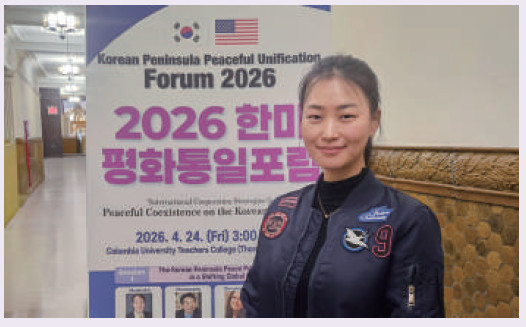
Kim Balgum, Graduate Student, Columbia University
"This forum was a meaningful opportunity to reflect once again on Korea, the United States, and the significance of peace on the Korean Peninsula. It prompted me to think about the role I can play from where I am, and as an overseas Korean, I was able to reflect on how I can contribute to Korea's public discourse and political landscape. It was an inspiring experience that gave me much to think about and helped me consider the direction I want to take going forward."
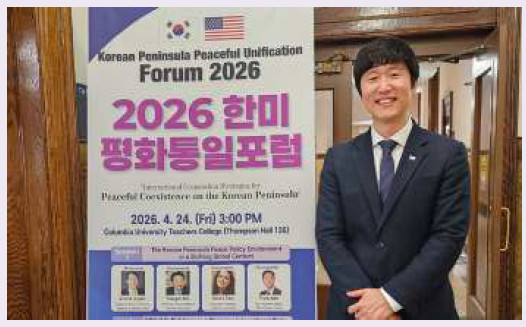
Kim Jinha, Graduate Student, Columbia University
"It was both a privilege and a deeply rewarding experience to take part in the Korea–U.S. Peaceful Unification Forum and to work alongside distinguished scholars, professors, and policy experts.
In particular, the forum gave me an opportunity to think about how we can create an environment in which the Korean Peninsula can coexist peacefully with the international community. Personally, I am interested in peacebuilding through education, and I hope there will be continued opportunities for research and collaboration involving young people from both Koreas and the international community."
-
How satisfied are you with the information you have reviewed?